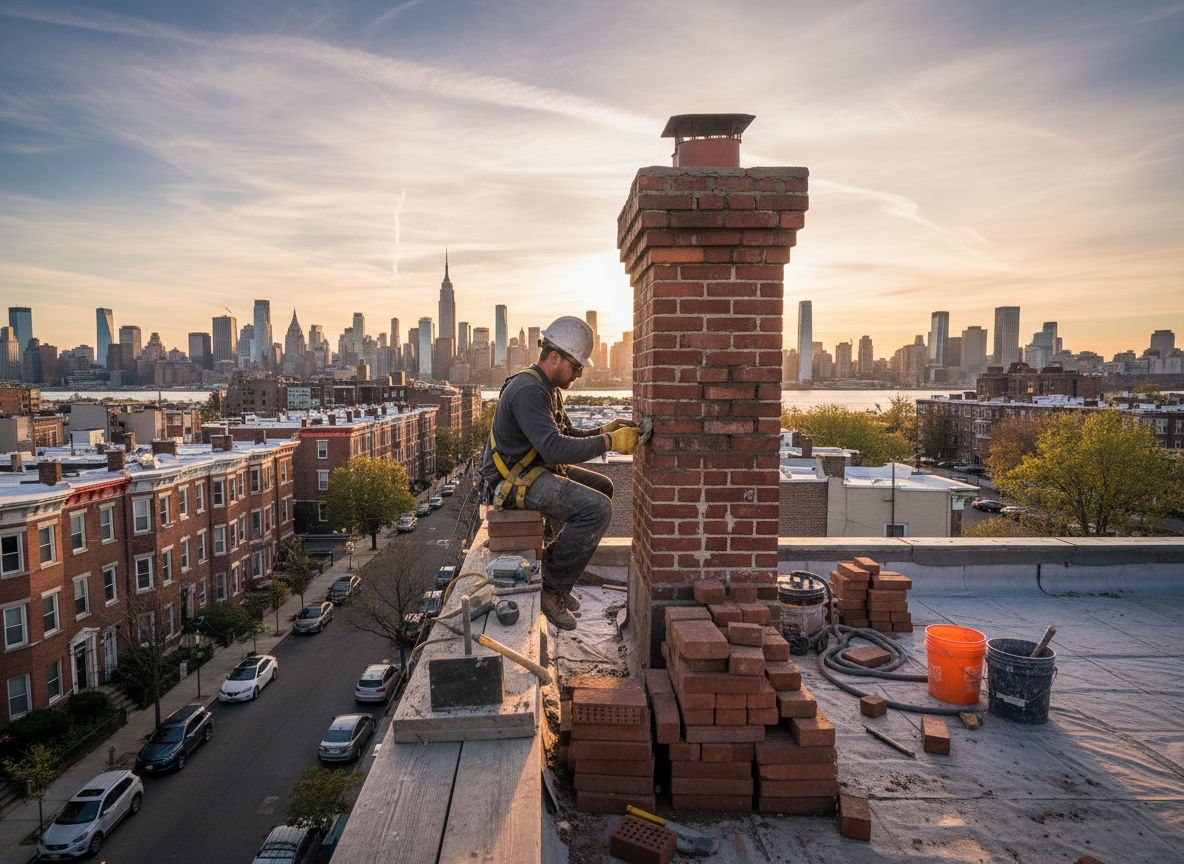
West New York sits in a humid subtropical climate where hot summers give way to cold winters that drive repeated freeze-thaw cycles. Older brick row homes in Downtown West New York and The Heights commonly show spalling bricks, eroded mortar joints, and hairline cracks that allow water to reach the flue liner. Proximity to the Hudson River Waterfront adds constant humidity and wind-driven rain that accelerates deterioration compared with inland neighborhoods in Union City or North Bergen.
Chimney repair here often involves repointing with type-N mortar matched to the original soft brick, installing stainless-steel caps to block rain, and rebuilding crowns that have delaminated from ice expansion. Terrain near North Hudson Park creates micro-climates where shaded chimneys stay wet longer, increasing the chance of hidden interior damage that only shows up after heavy spring rains. Technicians must also watch for shared flues in attached homes, where one owner's repair can affect draft in the neighboring unit.
Access in these dense blocks frequently requires scaffolding along narrow side yards or roof staging from the rear alley, and any work near the riverfront must account for higher wind loads that can loosen new flashing if not secured properly. Routine inspection after the first hard freeze catches most issues before they turn into interior water stains or carbon-monoxide pathways.
Technician insight
In West New York, the thing that catches most people out with professional chimney repair is how the freeze-thaw cycles hit older brick chimneys hardest on the river side of The Heights. Homeowners wait until interior stains appear, but by then moisture has already traveled down the shared flue into the next unit. Checking the crown and cap right after the first hard freeze prevents most callbacks.
Water Intrusion After Winter in The Heights
A homeowner in The Heights noticed ceiling stains following repeated cold snaps. Inspection revealed eroded mortar and a cracked crown allowing water to travel down the flue. We repointed the joints, rebuilt the crown with proper slope, and added a stainless cap. No further leaks occurred through the next winter season.
How it works
- 1
Site Assessment
Walk the roof and interior to map cracks, spalling, and liner condition while noting exposure to the Hudson River wind patterns.
- 2
Material Matching
Select mortar and brick that match the original 1920s-1950s construction common in The Heights and Downtown West New York.
- 3
Targeted Repair
Repoint joints, rebuild crown or cap, and seal flashing without full teardown unless structural failure is confirmed.
- 4
Final Draft and Leak Test
Run a smoke test and water spray to verify the repair holds under typical winter conditions before leaving the site.
Pricing
Upfront quotes after inspection; final cost depends on height, access, and extent of brick or liner damage typical in Hudson County homes.