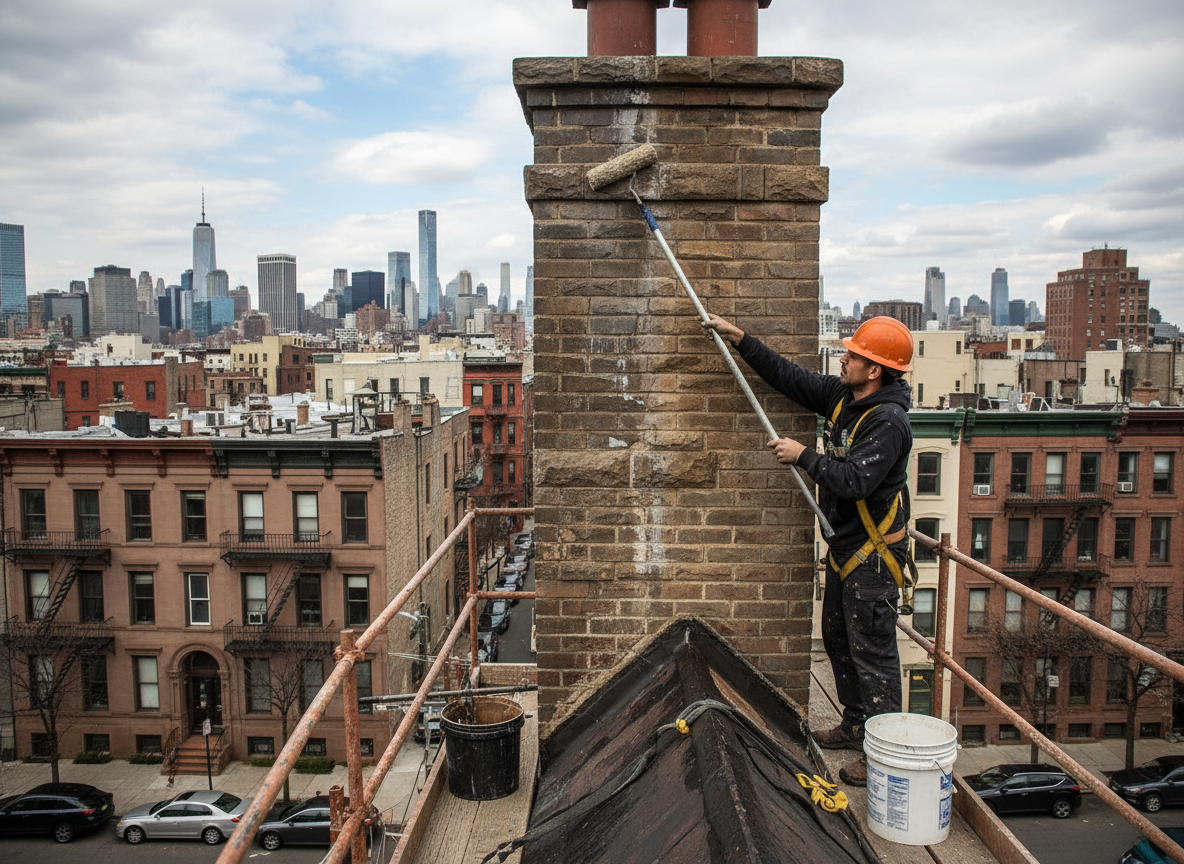
West New York sits in Hudson County along the Hudson River Waterfront, where the humid subtropical climate brings hot summers and cold winters that drive repeated freeze-thaw cycles through brick and masonry chimneys. Homes in The Heights and Downtown West New York are often older row houses and multi-family buildings with shared chimney stacks that collect moisture from wind-driven rain off the river. Standard cementitious sealers fail quickly here because they cannot flex with the thermal movement common in these structures. Proper waterproofing requires breathable silane or siloxane penetrants that allow vapor to escape while blocking liquid water, applied after thorough cleaning of soot and efflorescence.
Edge cases appear regularly near North Hudson Park where tree cover increases shade and slows drying, leaving chimneys damp longer after storms. Union City and North Bergen share the same ridgeline exposure, so wind loads push rain into flue joints and crown cracks that standard caps do not fully address. Technicians must check for missing mortar in the flue tile and deteriorated flashing at the roof line before any coating goes on. Skipping these steps allows water to migrate into the attic or wall cavities, creating hidden rot that only shows up after several seasons.
Code compliance in Hudson County requires that any work on chimneys serving fuel-burning appliances maintains proper clearances and does not trap combustion gases. Waterproofing products must be labeled for high-temperature flue environments and applied only to the exterior masonry, never inside the flue. Homeowners in West New York often attempt DIY sprays from big-box stores that create a surface film that peels within two winters, trapping moisture behind it and accelerating spalling of the brick.
Seasonal timing matters because the product needs several days of dry weather after application. Scheduling in late spring or early fall avoids the peak summer humidity that slows curing and the sudden cold snaps that can damage uncured material. After treatment, annual inspections remain necessary because the riverfront salt air gradually reduces the effectiveness of even high-quality sealers.
Technician insight
In West New York, the thing that catches most people out with chimney waterproofing is the wind-driven rain off the Hudson River that soaks the west-facing sides of chimneys in The Heights first. Older brick in Downtown buildings has already lost some of its original density, so the sealer has to be chosen for deep penetration rather than surface film. Homeowners often skip checking the crown and flashing, then wonder why water still appears inside after the walls are coated.
Water intrusion in a Heights row house
A homeowner in The Heights reported damp patches on an interior wall after heavy winter rain. Inspection showed cracked crown and open mortar joints on the chimney shared with the neighboring property. We cleaned the stack, repaired the crown, and applied two coats of siloxane sealer to all exposed masonry. The leaks stopped and the brick dried out over the following weeks.
How it works
- 1
Site Assessment
Technician examines the full chimney stack from roof to basement, checking crown, flashing, and mortar joints for existing water paths.
- 2
Surface Preparation
Loose material and biological growth are removed with low-pressure washing and wire brushing so the waterproofing can penetrate the masonry.
- 3
Product Application
Two coats of breathable silane-siloxane sealer are applied by brush and roller to all exterior brick and stone surfaces above the roof line.
- 4
Final Inspection
After curing, the chimney is checked for uniform coverage and proper water beading before the homeowner is shown the results.
Pricing
Upfront quotes provided after on-site inspection; cost varies with chimney height, access, and condition of the masonry.