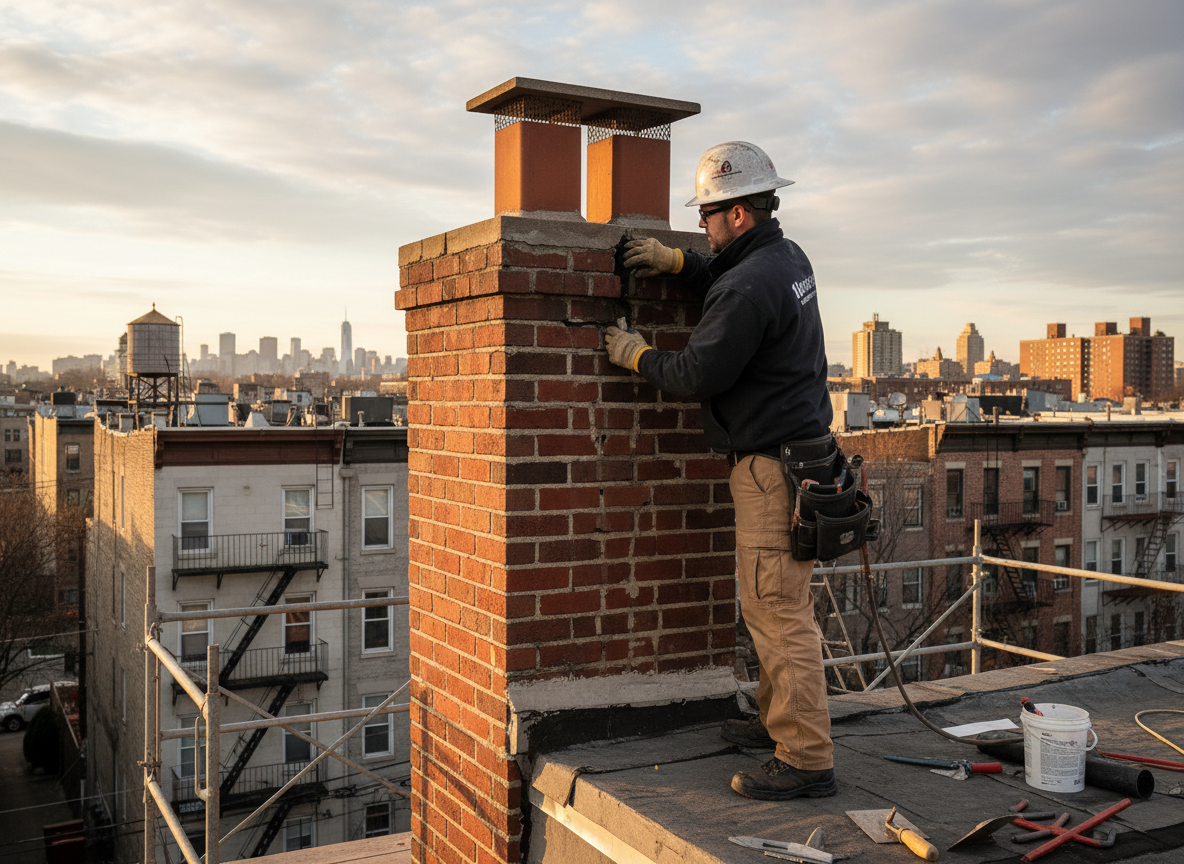
Chimney leaks in West New York often trace to failed flashing or cracked crowns where older brick stacks meet rooflines. Homes in The Heights and Downtown sit in a humid subtropical climate that brings hot summers followed by cold winters, so repeated expansion and contraction around mortar joints lets water track down into attics. Proximity to the Hudson River Waterfront adds steady moisture that speeds deterioration on north-facing chimneys. Proper repair requires removing loose material, installing new step flashing that ties into existing roofing, and rebuilding the crown with a slope that sheds water rather than pooling it.
Access matters on these jobs because many West New York roofs are steep or blocked by tight lot lines near North Hudson Park. We work from ladders or scaffolding rather than risking damage to neighboring structures common in Hudson County row-house blocks. Sealants alone rarely hold through another winter here; we combine mechanical flashing with compatible mortar mixes that match the original masonry color and texture so the repair blends without standing out. Ignoring the leak lets water reach ceiling joists and insulation, turning a roofline issue into interior mold growth that spreads faster in our humid summers.
Before any work we check the chimney chase for proper clearances to combustible framing, a frequent shortfall in pre-1960s homes throughout Union City and North Bergen. We also verify the flue liner remains intact so combustion gases stay separated from the repaired exterior. Homeowners sometimes attempt temporary tar patches from big-box stores, but those fail within months once freeze-thaw cycles resume and the underlying flashing continues to shift.
Technician insight
In West New York, the thing that catches most people out with chimney leak repair is how the freeze-thaw cycles from our cold winters loosen the original flashing on brick chimneys in The Heights faster than homeowners expect, especially on homes within a few blocks of the Hudson River Waterfront where constant humidity keeps the masonry damp.
Ceiling Stain After Winter Storms
Water stains appeared on a second-floor ceiling in a Downtown West New York row house after several freeze-thaw cycles. Inspection showed cracked crown and displaced step flashing on the chimney. We rebuilt the crown, replaced the flashing, and sealed the joints. No further leaks occurred through the next heavy rains.
How it works
- 1
Initial Assessment
We arrive at the property and inspect the chimney exterior, roof intersections, and interior attic space for active water paths.
- 2
Diagnosis and Access Setup
We identify the exact failure point, set up safe ladder or scaffold access, and protect surrounding roofing and siding.
- 3
Repair Execution
Damaged flashing and crown sections are removed, new compatible materials installed, and all joints sealed against Hudson County weather.
- 4
Final Verification
We test the repair with water and confirm no further intrusion before cleanup and departure.
Pricing
Upfront quotes provided after on-site inspection; cost varies with roof pitch, chimney height, and extent of masonry damage.