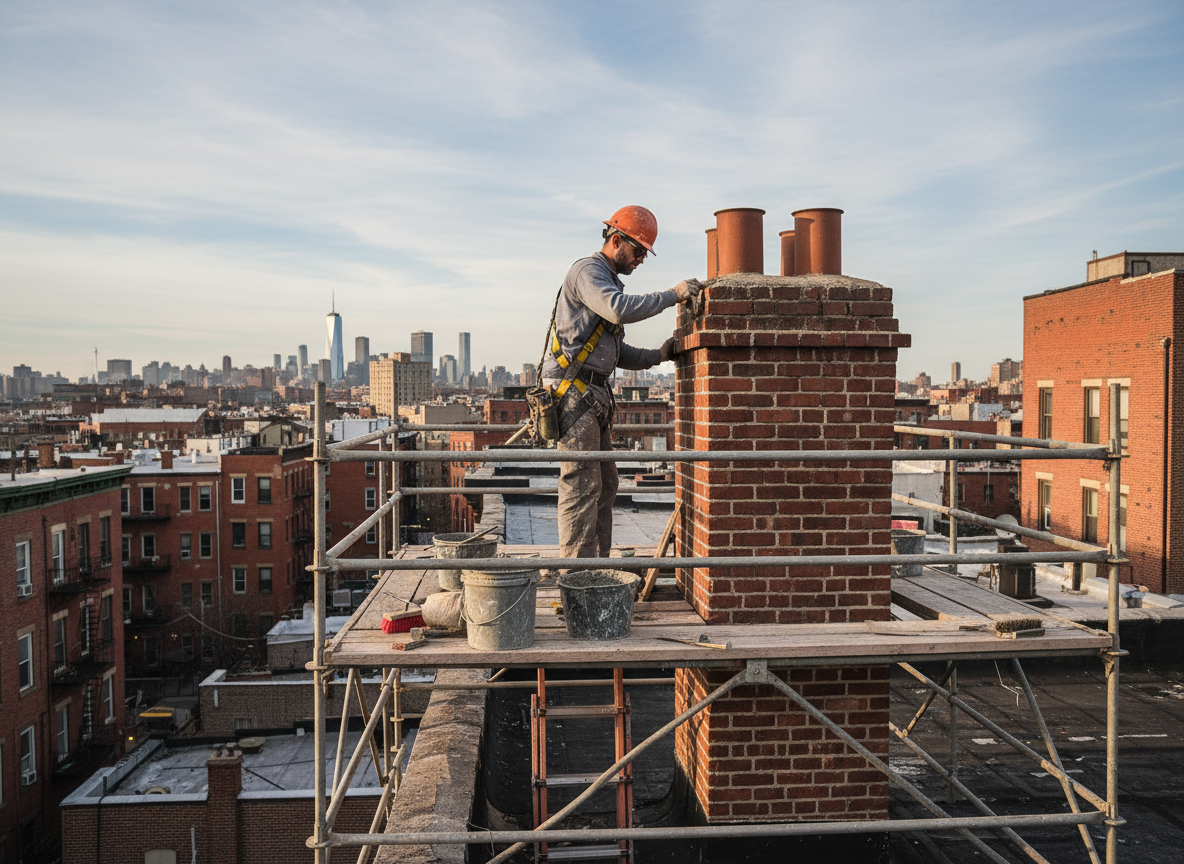
Homes built before 1950 in Downtown West New York and The Heights often have single-wall brick chimneys that suffer from freeze-thaw cycles once winter temperatures drop below freezing. Salt-laden air drifting from the Hudson River Waterfront speeds mortar joint erosion, allowing water to reach flue tiles and create interior staining on upper floors. We focus on targeted tuckpointing and crown sealing using lime-based mortars that match the original expansion rates rather than modern Portland mixes that can accelerate cracking.
In Hudson County the combination of humid summers and sudden cold snaps creates condensation inside flues that never fully dries, rusting damper assemblies and flue liners. Many two-family houses near North Hudson Park also have shared chimneys where one unit's appliance venting affects the other, requiring coordinated repairs to meet current Hudson County mechanical code venting separation rules. We map each flue run with a camera before any work so owners see exactly where the water path starts instead of guessing at the roof line.
Edge cases we see regularly include chimneys that lean slightly toward the river due to soil settlement along the waterfront bluff and those with terra-cotta flue tiles cracked by past coal use. These require stainless-steel liner insertion sized to the appliance rather than full demolition. We never recommend rebuilding when a properly installed liner plus new crown and flashing will restore safe operation at a fraction of the cost.
Technician insight
In West New York the thing that catches most people out with affordable chimney repair is how the constant wind off the Hudson River Waterfront drives rain sideways into The Heights chimneys that sit higher than surrounding roofs, so a simple crown fix often fails unless the flashing is also reworked to shed that angled water.
Shared Flue Leak in a Two-Family Near North Hudson Park
Water stains appeared on the second-floor ceiling of a house in The Heights after a cold snap. Camera inspection showed the shared chimney had open mortar joints where the flue passed the attic, allowing condensation and wind-driven rain to track down the common wall. We performed targeted tuckpointing and installed a stainless-steel liner sized for both appliances. No further staining occurred the following winter.
How it works
- 1
Site Inspection
We examine the chimney from crown to cleanout, check for water staining inside the home, and run a camera through each flue serving properties in West New York, Union City, and North Bergen.
- 2
Moisture Path Mapping
Using the camera footage we identify whether leaks enter at the crown, flashing, or through eroded joints common on The Heights side of town.
- 3
Targeted Repair Plan
We present two or three repair options ranked by cost, always starting with the least invasive method that addresses the actual water entry point.
- 4
Execution and Final Check
Repairs are completed, then we re-inspect with the camera and test draft under cold conditions to confirm the fix holds through a Hudson County winter.
Pricing
Upfront written quotes after inspection; cost driven by access, number of flues, and whether a liner is required.